
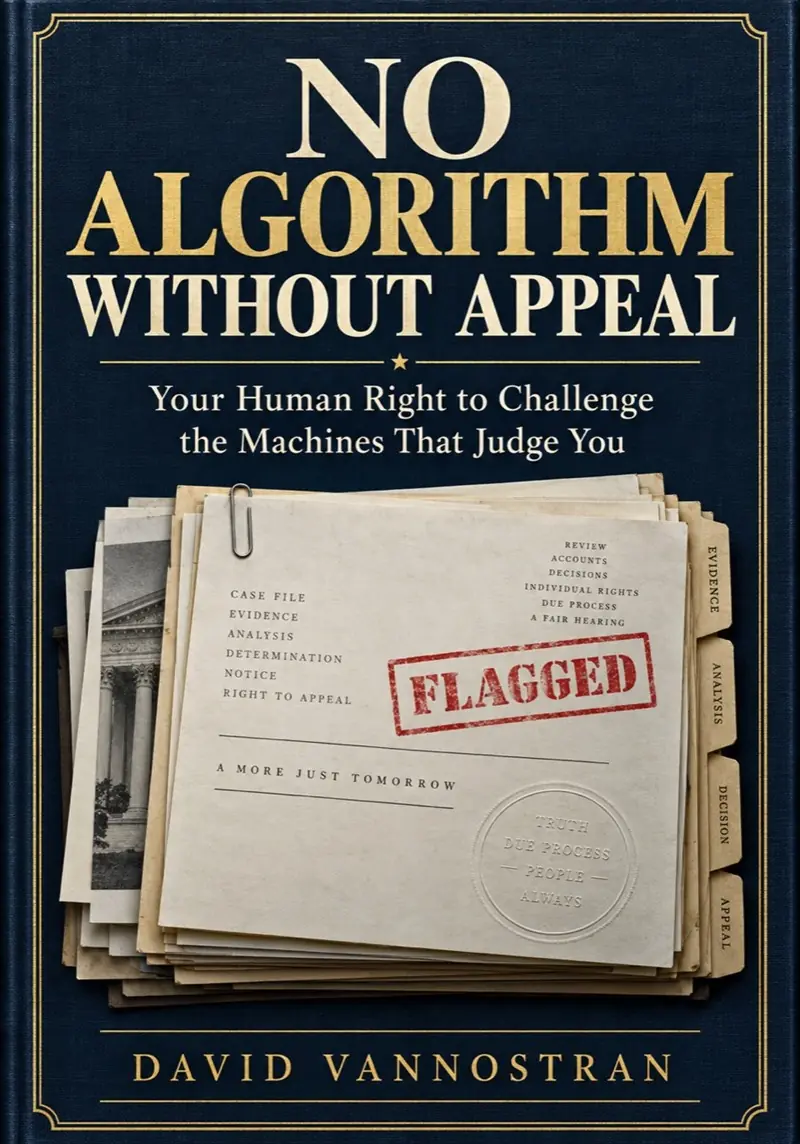
By David Vannostran
No Algorithm Without Appeal
Your Human Right to Challenge the Machines That Judge You
What happens when an algorithm decides whether you get the job, the loan, the insurance policy, the public benefit—or the attention of law enforcement?
Available in paperback, hardcover, and Kindle
Available editions
Paperback$19.99
ISBN: 979-8-90797-718-1
Hardcover$29.99
ISBN: 979-8-90797-721-1
Kindle$9.99
Digital edition
Prices shown in U.S. dollars. Amazon prices and availability may vary.
At a glance
Questions this book explores
- What is this book about?
- A constitutional and practical framework for preserving notice, reasons, evidence, human review, and a meaningful right to appeal when automated systems shape consequential decisions.
- Who is it for?
- Readers, professionals, policymakers, and citizens concerned with artificial intelligence, due process, civil liberty, and institutional accountability.
- What central question does it ask?
- What rights should a person retain when an automated system influences a consequential decision?
About the book
The machine may assist.
The institution must answer.
Automated systems increasingly screen applicants, rank workers, calculate risk, detect fraud, evaluate claims, recommend content, and identify people for investigation. These systems can improve speed, consistency, and accuracy. But when an institution treats a machine's output as sufficient reason to act, technology becomes an exercise of institutional power.
No Algorithm Without Appeal examines what happens when that power is difficult to see, explain, question, or reverse. The greater danger is not artificial intelligence itself, but unaccountable judgment: a system in which no person can identify the evidence, explain the conclusion, accept responsibility, or correct a consequential mistake.
At the center of the book is a practical framework built around seven guarantees: notice, actual reasons, access to material evidence, an opportunity to correct facts and rebut inferences, meaningful human review, preservation of the decision record, and a timely, effective remedy.
The answer is not to reject innovation. It is to preserve the human capacity to question power. Efficiency matters, but a person whose liberty, livelihood, reputation, or legal status is at risk must remain more than a data profile, probability score, or flagged account.
More from Vannostran Press